The Book
The Spirit of Santa
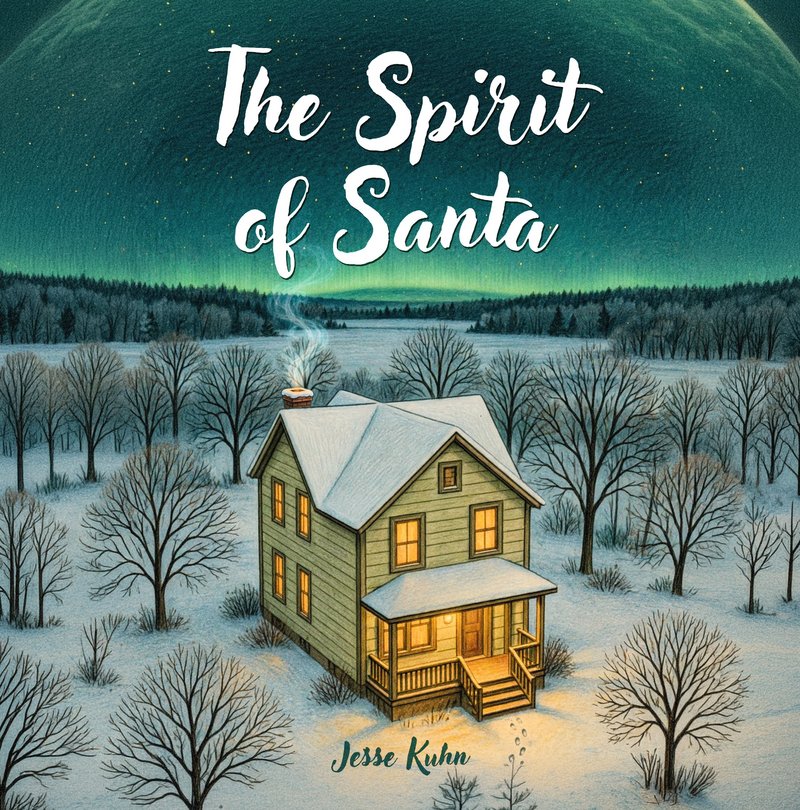
The book introduces children and families to a broader understanding of Santa through storytelling, generosity, seasonal change, wonder, and the ways human beings have cared for one another across generations. It does not ask a family to give anything up. It asks what the tradition might mean when a child is ready to hold more of it.
Through the story, a lantern is built — slowly, across the pages, without explanation: materials gathered, a frame taking shape, paper stretched and joined, until at last it is lit and released into the winter sky. Above it all, when the night is clear, the northern lights move across the dark.
- Author & IllustratorJesse Kuhn
- PublisherTorchbearer Press
- FormatPicture book, 8.5 × 8.5 in, full premium color — softcover and hardcover
- ForChildren roughly 4–9, and the adults who read with them
- OrderOrder the book at Always Here
- CompanionThis website: history, parenting resources, family traditions
Who it is for
For parents of children in the thick of wonder — old enough to ask real questions, young enough to still be listening for hooves on the roof. For families who love their Christmas traditions exactly as they are and also sense that the story underneath them is bigger than the one usually told. And for any adult who has ever stood in a hallway at midnight, mid–gift-wrapping, wondering how to honor both the magic and the truth.
What it is not
It is not an exposé, and it does not recruit children into keeping a secret. It does not tell any family that its way of celebrating is wrong. The book’s working rule, from its first draft onward: zero collapse of tradition; full elevation of meaning. Whatever is already in play under your roof can continue — and be lifted at the same time.
Questions about the book
No. The book never stages that confrontation. It widens the story instead — toward the real people, real history, and real generosity that have always stood behind the figure — so that as a child’s understanding grows, the tradition grows with it rather than collapsing.
The read-aloud sweet spot is roughly ages 4 to 9 — the years when questions about chimneys, reindeer, and logistics begin in earnest. Younger children hear a winter story about kindness and light; older children hear the layer underneath it. It is designed to be read more than once, differently each year.
Both, by design. The book treats the religious, cultural, and purely familial ways families keep this season as equally legitimate. It requires no particular belief and argues against none. Families who celebrate Christmas as a holy day and families who celebrate it as a winter festival of generosity will each find their own tradition respected — and intact.
The book doesn’t say — deliberately. The lantern is a visual thread, not a symbol with an assigned meaning: something made by hand, lit with care, and let go. Families tend to find their own meaning in it. If you’d like to build a small lantern ritual of your own, the Family Traditions library has safe, practical ways to begin — no airborne flames required.
The book is available from Torchbearer Press — order it at Always Here, where the product page carries current availability and format details. This website’s libraries are free and complete whether or not you ever buy the book — that independence is part of the project’s design.
Yes — that’s the rest of this site. The history library follows Santa’s story from fourth-century Myra to the twentieth century, with sources. The parents library takes up the questions children ask and the ones parents ask afterward. The book’s deeper material lives here, deliberately: the story itself stays clean and complete for a child reading alone.